Mid Fade Haircut: The Complete Style Guide for Men
The mid fade is the haircut most guys picture when they think of a modern, clean cut. It sits in the sweet spot: sharp and current without being as bold as a high fade or as quiet as a low fade. It reads well in an office, at the gym and on a night out, which is why it has been the most-requested fade height in barbershops for years running.
This guide covers exactly what a mid fade is, where the line falls on your head, the thirty-odd variations worth knowing grouped so they actually make sense, who each one suits, the words and guard numbers to use in the chair, and how to keep the blend crisp between visits.
Last updated: July 2026 · 10Trim Editorial Team
Jump to a Section
- What is a mid fade haircut?
- Where the line falls: the mental diagram
- Mid vs low vs high, at a glance
- How to choose: face shape and hair type
- Variations 1: how the fade finishes
- Variations 2: what you keep on top
- Variations 3: by hair type and texture
- Variations 4: professional, edgy and athletic
- The back of a mid fade
- How to ask your barber (with guard numbers)
- Maintenance and how often to go back
- Cutting a mid fade at home
- The tools that actually matter
What Is a Mid Fade Haircut?
A fade is a gradual taper where the hair blends from very short at the bottom up to longer on top, with no visible line where one length stops and the next begins. Every fade uses the same technique. The only thing that changes between them is where that blend starts on the side of your head, and "mid" is the answer to that question.
On a mid fade, the taper begins around the middle of the side of the head — roughly level with your temple, in the band between the top of your ear and your temporal ridge. Below that point the hair blends progressively down toward skin or a very short guard. Above it, the hair keeps whatever length you want for the style on top.
That placement is what makes the cut so useful. It exposes enough of the side to look deliberate and crisp, but it stops short of the dramatic, high-contrast look of a shaved-high fade. You will see it searched and requested as a medium fade haircut, a mid fade men's haircut, a men's mid fade haircut or simply "a fade on the sides" — all the same cut. If someone walks into a shop and asks for "a men's haircut with a fade" without specifying a height, a mid fade is very often what the barber reaches for, because it is the safest default.
It is worth saying what a mid fade is not. It is not a specific length, and it is not a specific guard number. It is a position. Two guys can both have a mid fade and look completely different depending on whether the bottom finishes at skin or at a number two, and whether they have two inches on top or half an inch.
Where the Line Falls: The Mental Diagram
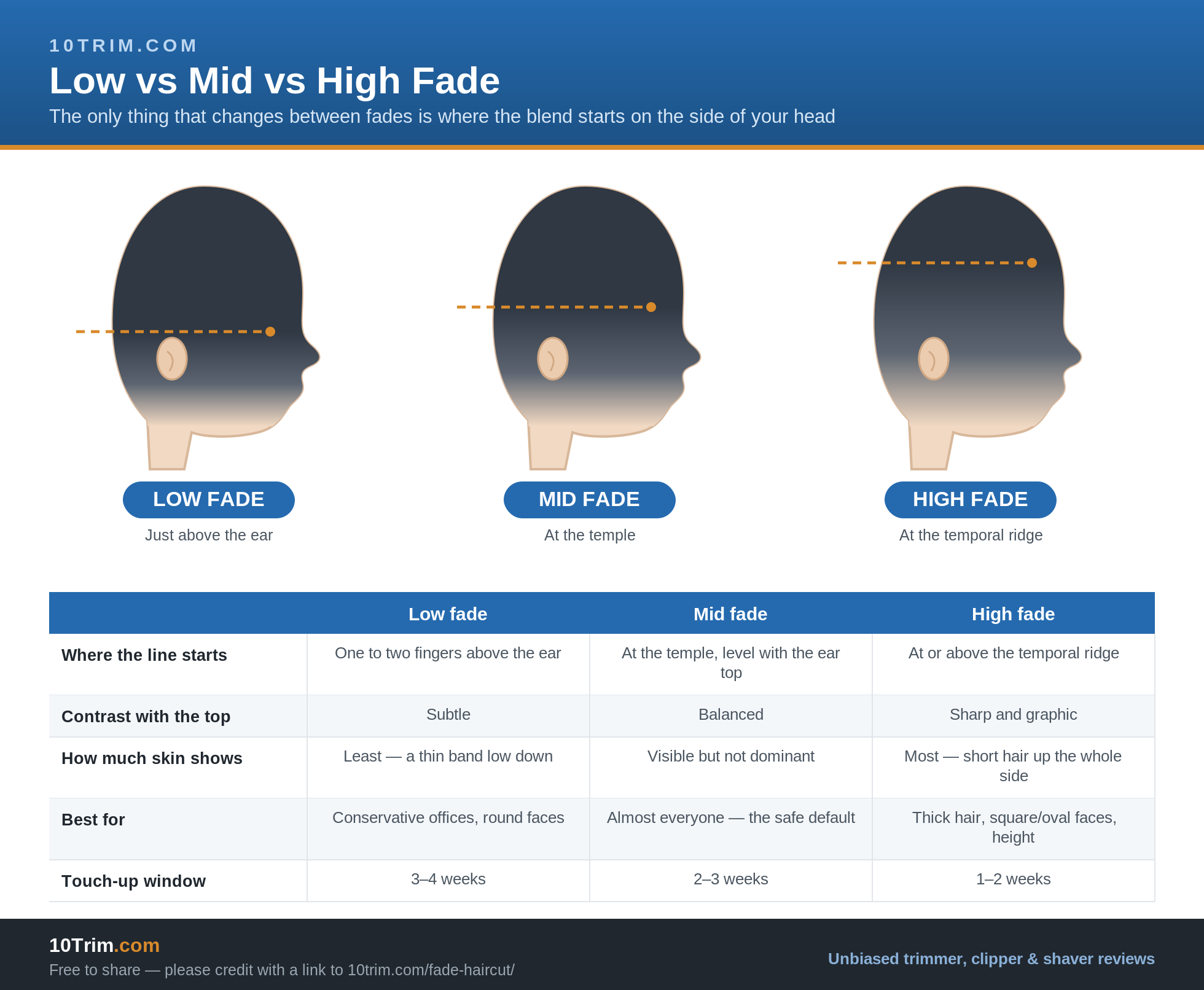
Share this infographic on your site
Free to use with credit to 10Trim — copy this code:
Most people looking for a mid fade haircut diagram want one thing: a way to point at their own head and know they are pointing at the right spot. You do not need a picture for that. Use these landmarks.
Put a finger on the top of your ear. Now put another finger on your temple, at the corner of your hairline where it starts to turn back toward your ear. The mid fade's starting line runs roughly through the middle of the gap between those two points, and it follows the curve of your head around toward the back rather than sitting dead level.
A few reference points that stop the confusion:
- Just above the ear and around the neckline is a low fade. That is lower than a mid.
- Level with or just below the temple is a mid fade.
- At or above the temporal ridge — the bony corner where the side of your head turns into the top — is a high fade.
The single most common mistake is thinking the fade line is the shortest point. It is not: it is where the blend starts from the top going down. Below the mid fade line, the hair keeps getting shorter until it reaches its shortest at the very bottom, at the hairline. Guys who ask for a mid fade and are surprised at how much skin they see near the ear have usually misread this.
You will also hear barbers and clients talk about fade levels or degrees. There is no industry-standard numbering for the heights — low, mid and high are the whole vocabulary, and everything else (drop, burst, temp, taper) describes the shape of the line, not its height. Our breakdown of every type of fade haircut maps them all out if you want the full family tree.
Mid vs Low vs High, at a Glance
| Height | Where the blend starts | Contrast | Best if… |
|---|---|---|---|
| Low fade | Just above the ear and around the nape | Subtle | Conservative workplace, growing out a longer cut, or you want the shape to survive four weeks |
| Mid fade | Around the temple, halfway up the side | Balanced | You want it to look obviously fresh without it being the loudest thing about you |
| High fade | At or above the temporal ridge | Sharp | You want maximum contrast with the top and do not mind a two-week cycle |
Guys often ask for something in between — a medium high fade or a mid to high fade — and that is a real request, not a contradiction. It means take the line up toward the temporal ridge but stop before it. Any competent barber will understand it if you point. If you are still weighing the three against each other, the quick-reference table below puts each line against a specific anatomical landmark and covers what each height does to your head shape and how often it needs a touch-up.
Low vs Mid vs High: Where the Line Sits
Low, mid and high are the same haircut with the fade line set at three different heights. Here is where each one lands, how much skin it shows, and how often you will be back in the chair.
| Low fade | Mid fade | High fade | |
|---|---|---|---|
| Where the line starts | One to two finger-widths above the ear, following the hairline | At the temple, level with the top of the ear | At or above the temporal ridge, near the corner of the head |
| How much skin shows | Least — a thin band low on the sides | Balanced — visible but not dominant | Most — short hair covers the whole side |
| Contrast with the top | Subtle | Moderate | Sharp and graphic |
| Best for | Conservative offices, round or wide faces, first-time faders | Almost everyone — the safe default | Square or oval faces, thick hair, anyone wanting height |
| Touch-up window | 3–4 weeks | 2–3 weeks | 1–2 weeks |
One check overrides the rest: forehead height. Taking the sides up high raises the whole visual frame of your face and effectively adds forehead, so if yours is already tall, drop a level. A mid fade puts the line at the temple — the balanced middle ground the rest of this guide is built around.
How to Choose: Face Shape and Hair Type
The mid fade flatters more people than either extreme, which is most of the reason for its popularity. Where it still pays to be deliberate is in what you leave on top — the fade handles the sides, but the top is what balances your face.
| Face shape | What to do on top | What to avoid |
|---|---|---|
| Round | Height. A quiff, pompadour or textured crop with lift adds vertical line and lengthens the face | Flat, forward-combed styles that widen the silhouette |
| Square | Almost anything. A crop, comb over or short quiff all work | Nothing much — this is the easiest shape to cut for |
| Oval | Anything, but a side part or comb over is the classic | Heavy fringes that shorten the face |
| Long / oblong | Keep the top moderate and let some width sit at the sides. A textured crop or fringe works | Tall pompadours, which stretch the face further |
| Diamond / heart | Fringe or forward-textured crop to soften a narrow chin or wide cheekbones | Slicked-back styles that expose the full forehead |
| Hair type | How the mid fade behaves | Best pairing |
|---|---|---|
| Straight, fine | Shows the blend precisely — every bit of a barber's skill is visible, good or bad | Comb over, side part, short quiff with a matte product for grip |
| Straight, thick | Can get boxy on top if left too heavy; the fade takes the bulk off the sides | Textured crop, point-cut on top to break up weight |
| Wavy | Very forgiving — the wave hides small imperfections in the blend | Medium-length crop, messy quiff, longer fringe |
| Curly / coily | Superb match: the fade contains the width and lets the curl be the shape | Curly top, sponge twists, high-top; see the dedicated guide below |
| Thinning or receding | Genuinely helps — tighter sides cut the contrast against a thinner top and pull attention up and back | Short textured crop or caesar, never a comb over across a thin patch |
Variations 1: How the Fade Finishes
"Mid fade" tells your barber the height. The next decision is what the blend does at the bottom and what shape the line takes. These are the variations that change the cut itself rather than the styling.
Mid Taper Fade
The blend drops to a short length but stops before skin, leaving a soft, low-guard buzz at the very bottom instead of bare scalp. It is the most forgiving version of the cut and by far the most practical for anyone who cannot get to a barber every fortnight.
- Best for: Anyone on a three-to-four week cycle, conservative workplaces, first-time fade clients.
- Worst for: Guys chasing maximum contrast, or with very dark hair on very pale skin who want the dramatic gradient.
- Length needed: Anything from half an inch on top upward.
- How to keep it: Refresh the bottom half with a #1 or #1.5 guard every couple of weeks and the shape holds well.
If you like the taper idea but want the line lower and softer still, a low taper fade is the more subtle sibling, and our overview of the taper fade covers where a taper and a fade differ in the first place.
Mid Skin Fade (Mid Bald Fade, Mid Zero Fade)
Here the blend runs all the way down to bare skin at the hairline. It is the sharpest-looking version by a distance, and it is what most people are picturing when they call something a medium skin fade haircut or a mid zero fade. "Zero" refers to the zero-length blade the barber uses at the bottom, not to a guard number.
- Best for: Maximum contrast, dark hair, anyone who genuinely will go back every two weeks.
- Worst for: Sensitive or reactive scalps, and anyone with a four-week barber habit — skin regrowth reads as stubble within days.
- Length needed: Any top length, though it looks strongest with real length up top for the contrast.
- Watch for: Irritation and small bumps at the bottom edge, where the blade works closest. Moisturize afterward and do not let a barber go over the same skin repeatedly.
The full breakdown of how close the blade goes and how to keep the scalp calm is in our skin fade haircut guide.
Mid Drop Fade
Instead of running level around the head, the fade line arcs downward behind the ear, dropping toward the nape in a curve. On a mid drop fade the line starts at temple height at the front and sweeps down at the back. It follows the natural curve of the skull, which flatters most head shapes and looks especially good with length on top.
- Best for: Flatter-backed heads, curly and wavy hair, anyone who finds a straight fade line looks severe on them.
- Worst for: Very short crops, where the arc has too little contrast to read.
- How to ask: "Mid fade with a drop behind the ear." Full detail in our drop fade guide.
Mid Burst Fade
The blend radiates outward around the ear in a semicircle, leaving weight at the back of the head rather than fading the nape. Paired with a mid starting height it is a favorite for mohawk-ish shapes, mullets and textured tops.
- Best for: Curly and textured hair, anyone keeping length at the back, a more expressive look.
- Worst for: Strict corporate settings — it is the least conventional of the group. See the burst fade guide for the variations.
Mid Temp Fade
A mid temp fade concentrates the work around the temple and the corner of the hairline, cleaning up that specific area rather than fading the whole side evenly. It is frequently combined with a line-up and is a staple on textured hair. Our temp fade guide covers how the temple line is built.
Mid Fade with a V or Angled Back
Some guys ask for a mid high V fade — the fade line rises toward the crown at the back, meeting in a soft V or point at the center of the nape rather than a straight or rounded neckline. It sharpens the back view and is worth requesting explicitly, because most barbers default to a rounded or squared neckline unless told otherwise.
Variations 2: What You Keep on Top
The sides are settled. Now the part that actually changes how the cut looks in a photo. All of these sit over an identical mid fade — only the top changes.
Mid Fade + Comb Over
The most reliable business-friendly combination there is. The faded sides keep it current, the swept top keeps it classic, and a hard part carved in with a trimmer sharpens it further if you want.
- Best for: Straight and slightly wavy hair, office settings, defined natural side parts.
- Worst for: Very curly hair, which will not lie down without effort.
- Length needed: Around 2 to 3 inches on top, shorter at the sides of the top section.
- Styling: Blow dry across the head, then a medium-hold pomade or cream.
Mid Fade + Quiff or Pompadour
Leave real length on top, style it up and back, and the clean sides make the volume pop. This is the go-to when you want height and a bit of presence.
- Best for: Round and square faces, medium-to-thick straight hair.
- Worst for: Fine, limp hair without a pre-styler; long faces, which get longer.
- Length needed: 3 to 5 inches at the front for a quiff, more for a true pompadour.
- How to grow: Expect two to four months from short, with the sides kept faded throughout so it never looks shaggy on the way.
Mid Fade + Textured Crop or French Crop
Short, point-cut, forward-styled top with a blunt or textured fringe. Currently the most-requested top style in barbershops and the lowest-maintenance of the group.
- Best for: Thick or coarse hair, receding hairlines (the fringe covers the corners), guys who want a two-minute morning.
- Worst for: Very fine hair, which struggles to hold the texture.
- Length needed: 1.5 to 3 inches, longer at the front than the crown.
- Styling: Matte clay, worked through dry hair with fingers. No comb.
Mid Fade with Long on Top
A mid fade haircut long on top pushes the contrast further: four inches or more up top over faded sides, worn slicked back, loose, or tied up. It is the version that suits a medium length men's haircut best, and it also gives you the most styling options on a given day.
- Best for: Thick hair with some natural movement, guys who want versatility.
- Worst for: Fine hair, which goes flat and stringy at that length.
- Length needed: 4 inches minimum, 6 or more for a bun.
- How to grow: Keep going back for the fade while the top grows — that is what stops the awkward phase.
Mid Fade + Short Crop or Buzz
At the other end, a mid fade over a very short top gives you a clean, low-effort cut with more shape than a plain buzz. This is what most people mean by a men's short fade haircut, and it is the easiest entry point into fades. Our short fade guide covers the shortest versions in detail, and our roundup of men's short haircuts puts it next to the crew cut and caesar.
Mid Fade + Slick Back or Fringe
A slick back over a mid fade is the sharpest formal option going — nothing on the face, everything swept clean. A fringe does the opposite, dropping hair forward to shorten a long forehead. Both use the same cut underneath; only the product and the direction change.
Variations 3: By Hair Type and Texture
Mid Fade for Straight Hair
A mid fade haircut for straight hair produces the crispest, most precise blend of any hair type, because straight hair shows every gradient step exactly as it was cut. That is a double-edged thing: a skilled barber's work looks incredible, and a rushed job shows lines you cannot hide. If your hair is straight, this is the type where it genuinely pays to find a barber who fades well rather than whoever is free.
- Best for: Comb overs, side parts, quiffs, clean crops.
- Worst for: Nothing in particular — straight hair handles every mid fade variation.
- Watch for: Visible banding in the blend. Point it out in the chair while you are still there.
Mid Fade on Curly Hair
Curls and a mid fade are a natural pairing: the fade takes the width out of the sides and lets the curl pattern on top be the whole shape. The one thing to plan for is shrinkage — curly hair sits shorter than it measures, so ask for more length on top than feels right. Because there is enough to say about curl type, top length and product, we have a full guide dedicated to the mid fade on curly hair.
Mid Fade on Afro-Textured Hair and 360 Waves
On an afro or high-top, a mid fade frames the height cleanly and stops the silhouette from reading as a soft dome. For guys brushing 360 waves, a mid fade is close to standard issue: it keeps the edges tidy while leaving enough length on top for the pattern to show. Pair it with a line-up at the temple and the neckline and the whole cut looks intentional.
- Best for: High-tops, sponge twists, waves, short coily crops.
- Length needed: Whatever the style on top demands; the fade is independent of it.
- Upkeep: Durag or wave cap nightly if you are brushing waves, plus a moisturizer — faded sides on coily hair dry out fast.
Mid Fade on Wavy and Medium-Length Hair
Wavy hair is the most forgiving texture for a fade, because the movement hides small imperfections. A mid fade with medium hair on top — three to four inches, air-dried with a sea salt spray — is one of the easiest good-looking cuts to maintain, since the top does not need daily precision.
Mid Fade with Thinning Hair
Counter-intuitively, a fade often helps a thinning crown. Cutting the sides tight reduces the density contrast between a full side and a sparse top, so the eye reads the cut as deliberate rather than as loss. Keep the top short and textured, skip the comb over across a thin patch, and let the fade do the work.
Variations 4: Professional, Edgy and Athletic
Same height, different intent. This is what people are searching for when they look for a men's professional fade haircut, a formal fade, an edgy fade or an athlete's fade.
- Professional / formal: Mid taper rather than skin, no hard part, no designs, comb over or side part on top. It looks polished at a distance and does not announce itself in a meeting.
- Edgy: Mid skin fade, hard part carved in with a trimmer, or a burst or drop line. Longer, messier texture on top. More contrast everywhere.
- Athletic: Mid skin fade with a very short textured crop. It stays out of the way, dries in seconds after training, and looks the same wet or dry — which is most of why it is the default in locker rooms.
If you want to see how the mid fade sits alongside the other cuts in rotation this year, our ranked list of the best men's haircuts to ask for puts it next to crops, undercuts, curtains and buzz cuts.
The Back of a Mid Fade
Almost nobody thinks about the back until they see the photo, and the back of a mid fade is where most cuts either look finished or look unresolved. Three things decide it.
Does the line stay level? A standard mid fade carries the same height around the back, giving a continuous band. A drop fade curves it down. A V fade angles it up to a point. Say which one you want; silence gets you the barber's default.
How is the neckline finished? A tapered (natural) neckline fades into the skin and grows out invisibly — the best choice for anyone on a longer cycle. A blocked (squared) neckline is a hard horizontal line, sharp for about five days and messy after. A rounded neckline splits the difference. For most guys with a mid fade, tapered is the right call.
Does the fade meet the beard? If you have facial hair, the fade should connect into the sideburn and down into the beard with no step or ledge. That connection is what separates a professional cut from a home job, and it is worth asking for explicitly — see our guide to the best beard styles for men for the shapes that connect cleanly.
How to Ask Your Barber for a Mid Fade
Barbers hear "just a fade" all day and it leaves far too much to guesswork. Six specifics get you the exact cut.
- Name the height and point to it. "Mid fade, starting about here" with a finger on your temple removes the biggest variable in one sentence.
- Name the finish. "Mid taper" if you want length left at the bottom; "mid skin fade" or "mid bald fade" if you want it down to bare skin.
- Name the shape of the line. Straight around, dropped behind the ear, or angled up at the back.
- Give the guard numbers if you know them. A useful shorthand is to state the range: "skin up to a 3" or "1 up to a 4." That is what guys mean by a 2 3 4 fade or a 3 2 fade — the sequence of guards the barber steps through going up the head. Note that some barbers work in blade sizes rather than guard numbers, where the numbering runs the opposite way (a 000 blade is closer than a 1). If someone says a "10 fade," they almost always mean a #10 blade, which is roughly a #1 guard in length, not a tenth guard.
- Describe the top. Say how you style it — comb over, quiff, crop, waves — and give a rough length in inches or finger-widths. "Leave two inches, scissor the top" is more useful than "not too short."
- Bring a photo. One clear reference beats a paragraph of description, especially for the height. Bring a picture of the back if you care about the neckline.
If guard numbers are the part that trips you up, our complete hair clipper guard size chart gives every number in inches and millimeters, plus how Wahl, Andis and Oster differ from each other.
Maintenance and How Often to Go Back
A fade looks its best for the first week to ten days. After that the blend starts to soften as the shortest sections grow fastest and catch up with the rest.
- Mid skin fade: every 10 to 14 days. Bare skin shows regrowth within about four days, and by week three the gradient has gone.
- Mid taper fade: every 3 to 4 weeks. The soft bottom edge hides growth far better.
- Longer tops: you can stretch a fade refresh between full cuts — ask for "just the sides cleaned up," which most shops charge less for and which takes ten minutes.
Between visits, three small things buy you a week or more. Clean the neckline with a trimmer, keeping the same shape rather than raising it (raising the neckline every week is how it creeps up your head). Keep the sideburns level with each other. And run a guard over the lowest section of the fade to restore some contrast — not the whole blend, just the bottom third.
For the top, match product to style: matte clay or paste for crops and textured looks, a firmer pomade for comb overs and quiffs, and a blow dryer on medium for anything that needs height. Most guys skip the dryer and then wonder why their quiff never looks like it did in the chair.
Cutting a Mid Fade at Home
A full fade on your own head is genuinely hard — the back is the problem, not the technique — but a maintenance fade between barber visits is very doable, and cutting one for someone else is easier than you would expect. The approach:
- Start on dry, clean hair and comb it into its natural fall. Wet hair cuts shorter than you think.
- Set your baseline at the bottom. Run your shortest guard (or the bare blade for a skin finish) from the hairline up to about an inch below where you want the fade to start.
- Work up in single steps. Next guard up, stop a little higher. Then the next. Three or four guards is plenty for a mid fade — there is no prize for using seven.
- Flick out at the top of each pass. Rock the clipper away from the head as you reach the top of the stroke. That arcing motion is what creates a blend instead of a shelf; going straight up and stopping is what creates the lines you are trying to avoid.
- Blend the ridges with the taper lever. Set the clipper to a mid-lever position with no guard and work horizontally across each visible line.
- Check in two mirrors, in daylight. Bathroom lighting hides banding that daylight will show.
Our full walkthrough on how to cut your own hair covers the mirror setup and the back-of-the-head problem in more detail.
The Tools That Actually Matter
You do not need a barbershop's worth of equipment, but a fade specifically rewards three things: a clipper with a proper taper lever, a full set of guards including a #0.5 and #1.5, and a separate T-blade trimmer for the neckline and edges. A single-length cheap clipper cannot blend, and no amount of technique fixes that.
As an Amazon Associate, 10Trim earns from qualifying purchases.


The taper lever is the part worth paying for. It lets you change the cutting length by a fraction with your thumb mid-stroke, which is how a blend gets built — swapping guards alone leaves steps. Barber-grade clippers all have one; most budget home kits do not, or have one with too little travel to be useful.


A T-blade trimmer is the second half of the job. It cuts right up to the edge of the blade, which is what you need for the neckline, around the ears, the temple line and a hard part. Trying to do edges with a full-size clipper is how home cuts end up looking approximate.
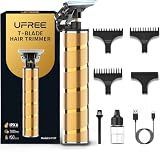


For a full comparison of what actually holds a fade — motor types, blade steel, battery life, and which models barbers reach for — see our tested roundup of the best hair clippers for men.
Frequently Asked Questions
Is a mid fade the same as a medium fade?
Yes. "Medium fade" and "mid fade" are two names for the same haircut — a fade where the blend starts around the middle of the side of the head, near the temple. Barbers use both terms interchangeably.
What number is a mid fade?
There is no single number, because a fade blends through several guard lengths rather than sitting at one. "Mid" describes where the blend starts on your head, not how short it is. When someone says a "number 1 mid fade," they mean the blend fades down to a #1 guard at its shortest instead of going to skin.
Is a mid fade better than a low fade?
Neither is better in the abstract. A low fade is subtler and grows out more gracefully; a mid fade gives more contrast and a more defined, modern finish. If your workplace is formal or you cannot get to a barber often, go low. If you want it to look obviously cut, go mid.
How often does a mid fade need touching up?
A mid skin fade needs 10 to 14 days; a mid taper holds for three to four weeks. You can stretch either by cleaning the neckline and refreshing the lowest section at home between full cuts.
Does a mid fade work with straight hair?
Very well. Straight hair shows the gradient with total precision, so a good blend looks exceptional — and a rushed one shows lines. It is the hair type where barber skill matters most.
Does a mid fade suit a round face?
Yes, provided you keep height on top. A quiff, pompadour or lifted textured crop adds vertical line and lengthens the face; a flat, forward-styled top will widen it.
Can you have a mid fade with long hair on top?
Absolutely, and it is one of the strongest versions of the cut. Four inches or more on top over faded sides gives you a slick back, a loose style or a bun from the same haircut. Thick hair carries it best.
What is the difference between a mid fade and a mid taper?
A mid taper is a mid fade that stops before skin, leaving a short guard length at the bottom. Every mid taper is a mid fade; not every mid fade is a taper.
Is a mid fade professional enough for an office?
A mid taper fade with a comb over or a neat crop is about as office-safe as a modern haircut gets. If your workplace is conservative, skip the skin finish, the hard part and any design.
Can I get a mid fade with a beard?
Yes, and connecting the two is one of the sharpest combinations in men's grooming. Ask the barber to blend the fade into the sideburn and down into the cheek line so there is one continuous taper from scalp to jaw, with no visible step.
What is a mid drop fade?
A mid fade where the line arcs downward behind the ear instead of running level, following the curve of the skull. It flatters flatter-backed heads and pairs especially well with length on top.
Will a mid fade work if my hair is thinning?
Usually yes. Tighter sides reduce the density contrast against a thinner top and shift attention to a well-styled crown. Keep the top short and textured rather than combing it across a sparse area.
The Bottom Line
The mid fade earns its reputation honestly. It is the most balanced of the three fade heights, it flatters nearly every face shape and hair type, and it adapts to whatever you want on top — comb over, quiff, crop, curls or waves. Get the height right by pointing at your temple, choose a taper or a skin finish based on how often you will realistically go back, and keep a clipper with a taper lever around for the in-between weeks.
If you are still comparing heights, put it side by side with a low fade and a high fade. And if you want the whole family in one place — taper, skin, drop, burst, temp and the rest — start with our complete fade haircut guide.
Related Info and Products:
- Low Fade Haircut: The Complete Style Guide for Men
- Burst Fade Haircut: The Complete Style Guide for Men
- High Fade Haircut: The Complete Style Guide for Men
- Low Taper Fade Haircut: The Complete Style Guide for Men
- Temp Fade Haircut: The Complete Style Guide for Men
- Skin Fade Haircut: Low, Mid and High Variations Explained
- Fade Haircut for Black Men: Best Styles and How to Ask
- Fade Haircut for Black Men: Types, Styles and How to Ask
- Complete Beard Style Guide: How to Style Your Beard in 2026
- Mid Fade Curly Hair: Best Styles, How to Ask, and Upkeep
Last update 2026-09-17. Price and product availability may change.
Leave a Reply